Most used car buyers in India start their search online. They search by make, model, budget, and location. They compare across multiple dealers before shortlisting. And they contact the ones whose online presence makes them feel like they’re dealing with someone legitimate.
The majority of used car dealerships in Kerala and across India are missing this window entirely — either because they have no website, because they only post on OLX and Facebook Marketplace, or because their website is a generic template with no live inventory.
This guide covers what a used car dealership website actually needs, why the inventory question is central to everything, and how to build a site that generates genuine buyer enquiries rather than just existing online.
The Trust Problem in Used Car Sales — and How Your Website Solves It
Used car buyers carry a specific anxiety: the fear of being misled. Odometer fraud, accident history, mechanical issues presented as minor — these concerns are real and widely shared. Before a buyer ever visits your showroom, they’ve already made a preliminary trust assessment based on what they find online.
A well-built used car dealership website does something a Facebook page or OLX listing can’t: it signals permanence and professionalism. It says this is an established business with a fixed location, a contact number that works, and cars that are actually available to view.
That trust signal is worth more than any particular listing feature. It’s the difference between someone shortlisting you and someone scrolling past.
Why Most Used Car Dealer Websites Don’t Work
Inventory that’s out of date. Nothing damages trust faster on a used car website than listings for cars that have already been sold. A buyer who calls about a car and is told “oh, that one sold last week” has wasted their time and lost confidence in your listings. Real-time or frequently updated inventory is the minimum standard.
No photos, or photos that look like they were taken on a Nokia. Used car buyers are making a visual decision before they contact you. A listing with no photos gets ignored. A listing with dark, blurry, or incomplete photos creates suspicion rather than interest. Each car should have multiple clear, well-lit photos: exterior from multiple angles, interior, dashboard, any notable condition issues.
No price. Listing cars without a price almost always backfires. Buyers interpret missing prices as “we’ll tell you when we know how much you look like you can afford.” It creates friction and sends the enquiry elsewhere.
Generic website with no real information. “We sell quality pre-owned vehicles at competitive prices” is the used car equivalent of “we’re passionate about what we do.” It says nothing. A buyer wants to know: what cars do you typically stock? What’s your price range? Where are you located? How do they get in touch about a specific car?
No WhatsApp integration. The entire used car buying journey in India runs through WhatsApp. A website that doesn’t have a direct WhatsApp link — ideally pre-filled with “Hi, I’m interested in the [car]” — is adding friction at exactly the moment a buyer is ready to act.
What a Used Car Dealer Website Actually Needs
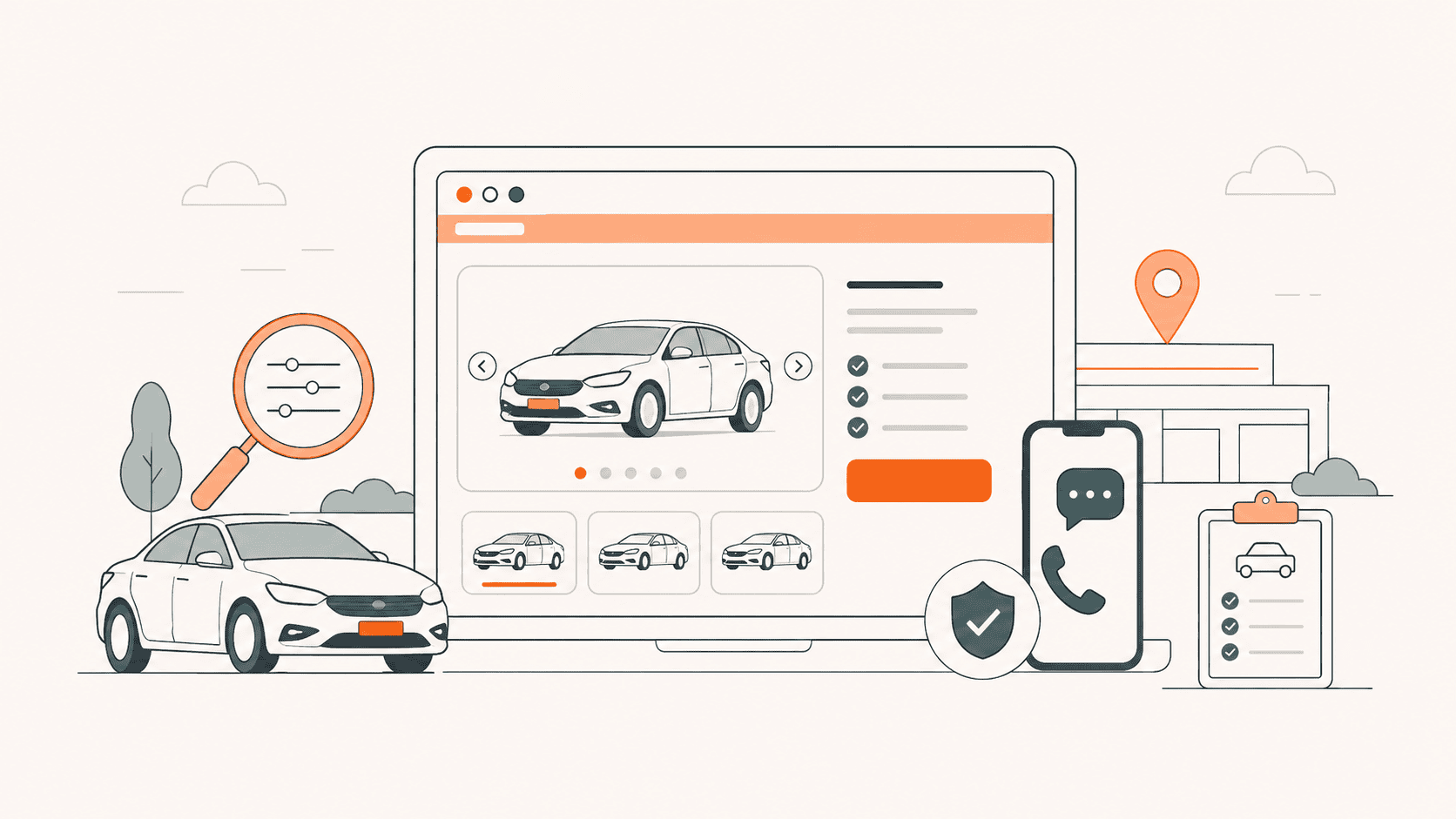
A live, searchable inventory. This is the central feature. Every car on your lot should be listed with make, model, year, mileage, colour, fuel type, transmission, asking price, and multiple photos. The inventory should be filterable — by brand, budget range, fuel type — so buyers can self-navigate to relevant options. And it should be updated regularly, ideally daily, so listings reflect actual availability.
A dedicated page for each car. Each listing should have its own URL — not because of SEO alone, but because it makes WhatsApp sharing trivially easy. When a buyer wants to ask about a specific car, they can send a direct link. This is how most actual used car enquiries work in practice.
Click-to-WhatsApp on every listing. A “WhatsApp about this car” button on every individual listing, pre-filled with the car’s details, removes every possible friction from the enquiry. A buyer doesn’t have to describe the car, find your number, or remember which listing they were looking at.
Trust signals throughout. How long you’ve been in business. How many cars you’ve sold. Whether you offer a basic inspection or mechanical check. A physical address with a Google Maps embed. A phone number that’s easy to find. A photo of your showroom or lot. These aren’t decorative — they’re reassurance signals for a buyer who’s deciding whether you’re worth visiting.
A clear selling/exchange process. Many used car buyers are also selling or exchanging an existing car. A simple “sell or exchange your car” section — even just a short description of how you assess trade-ins and a WhatsApp CTA — opens up an additional enquiry channel and positions your dealership as a one-stop option.
The SEO Opportunity Most Used Car Dealers Are Missing
Used car searches are unusually specific. People don’t just search “used cars in Kerala.” They search “used Toyota Innova 2019 Thrissur” or “second hand Swift diesel Palakkad under 5 lakh.”
Each of those searches is a highly qualified buyer with a specific intention. A dealership website with individual, properly described car listings — with make, model, year, location, and price in the page title — has a genuine chance to appear in those searches. Most competitors aren’t doing this.
The combination of specific inventory listings and locally-referenced content gives used car dealer websites an unusual SEO advantage: the inventory itself generates search visibility, updated with every new car added.
This is also why keeping inventory current matters beyond just user experience — stale listings reduce search relevance over time.
A Note on Inventory Management
A dynamic inventory — cars being added when they’re acquired, marked as sold when they’re gone, filterable and searchable — is a more technically involved feature than a standard business website. It requires a proper inventory management system, not just static pages.
At instabiz, this is handled as part of our custom scope for used car dealerships. The standard Get Online and Get Customers plans provide the foundation — professional site, WhatsApp integration, local search optimisation — and the inventory system is scoped based on the size of your lot and the features you need.
The result is a site where your inventory works as a continuous lead generation tool, rather than a static brochure.
Get Online — ₹999/month (billed annually) or ₹2,999/month rolling
Professional, mobile-friendly website with dealership information, contact integration, Google Maps, Google Business Profile setup, and monthly maintenance. A good foundation for smaller operations or those starting online for the first time.
Get Customers — ₹6,999/month
Everything in Get Online, plus local search optimisation, smart enquiry forms, instant WhatsApp and email alerts on new leads, active local ad management, and monthly results reporting. Limited availability.
Built For You — Price on request
For dealerships that need a live, searchable inventory with individual car listings, filtering, and WhatsApp integration per listing. Scoped after a conversation based on your lot size and requirements.
Frequently Asked Questions
Do I need a website if I already sell through OLX and Facebook Marketplace? Those platforms work for individual listings but they don’t build your dealership’s reputation. Buyers can’t easily see your full stock, your location, or your track record. A website is the place where everything lives consistently — your inventory, your contact details, your story — rather than scattered across platforms you don’t control.
How often do I need to update the inventory? Daily is ideal. At minimum, cars that have been sold should be removed within 24–48 hours. Nothing erodes buyer trust faster than contacting a dealer about a car that was already sold.
Can I list the same cars on the website and on OLX/Facebook simultaneously? Yes, and you should. Think of the website as the home base — the place that builds trust and houses the full inventory — and the marketplaces as distribution channels that drive traffic back to it.
What’s the minimum viable inventory to make a website worthwhile? Even with 10–15 cars, a well-presented online inventory is worth having. The key is quality over quantity — ten well-photographed, accurately listed cars will generate more enquiries than forty poor listings.
How long does the setup take? For a Get Online or Get Customers plan, 4 working days. For a Built For You scope with full inventory integration, timelines are discussed during the initial conversation depending on complexity.
If you run a used car dealership and want to know what an online presence that actually generates buyer enquiries looks like for your operation, start with a WhatsApp conversation.
instabiz builds and manages websites for used car dealerships and pre-owned vehicle businesses across Kerala and India. Plans start at ₹999/month with no setup fee.